
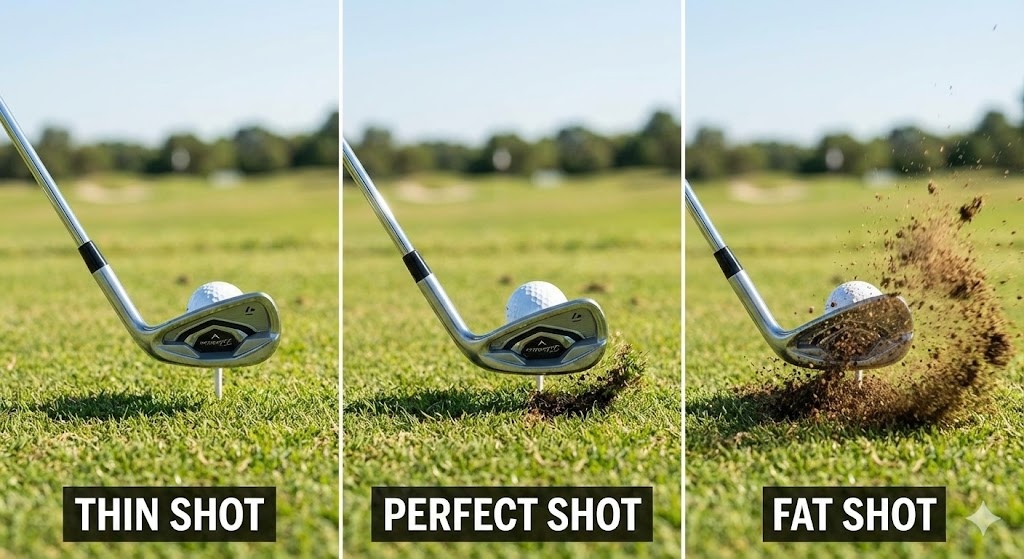
Few things frustrate golfers more than inconsistent contact. One swing digs into the turf. The next one barely skims the top of the ball. Confidence disappears quickly when fat and thin shots start to alternate.
This problem affects beginners and experienced players alike.
Fat and thin shots are not random. They come from predictable flaws in setup, balance, and swing control. Once those flaws are understood, clean contact becomes far more reliable.
You do not need a perfect swing to fix this issue. You need awareness, discipline, and a few key adjustments.
This guide explains how to stop hitting fat and thin shots by addressing the real causes rather than chasing temporary fixes.
Why Fat and Thin Shots Happen So Often
Contact errors come from impact position.
A fat shot occurs when the club strikes the ground before the ball. A thin shot happens when the clubhead rises too early and contacts the ball high on the face.
Both errors share a common cause. The low point of the swing is inconsistent.
When the swing bottom moves behind or ahead unpredictably, contact quality suffers. Balance shifts. Timing breaks down.
Understanding low point control is the foundation of learning how to stop hitting fat and thin shots.
Poor Setup Creates Contact Problems
Setup determines impact more than most golfers realize.
Ball position that drifts too far forward or backward disrupts low point control. Weight evenly distributed instead of favoring the lead side invites fat contact.
Posture also matters. Standing too tall or too bent alters swing plane and bottom location.
Grip tension plays a role as well. Excessive tension restricts natural release.
Correct setup simplifies everything. When alignment, posture, and ball position are consistent, contact improves automatically.
Weight Shift and Balance Errors
Balance issues create both fat and thin shots.
Falling backward through impact raises the swing bottom. The result is thin contact. Lunging forward too aggressively moves the bottom too early. Fat shots follow.
Proper weight shift remains subtle. Pressure favors the lead side while rotation continues smoothly.
Stable balance allows the club to return consistently.
Learning to control weight transfer is essential to stop hitting fat and thin shots.
Early Release and Casting
Casting refers to releasing the club too early in the downswing.
This early release moves the low point backward. Fat shots become common. Thin shots appear when compensation follows.
Casting often comes from trying to hit the ball harder. The hands throw the clubhead early. Control disappears.
Maintaining lag is not about force. It is about sequencing.
A smooth transition allows the club to release naturally near impact.
Overusing the Upper Body
Excessive upper body motion creates inconsistency.
When shoulders dominate the swing, lower body stability disappears. The swing bottom moves unpredictably.
Arms and hands then attempt to correct mid-swing. Timing suffers.
A balanced swing uses rotation rather than lunging. Lower body stability supports consistent contact.
Reducing upper body dominance helps stop hitting fat and thin shots.
Lack of Low Point Awareness
Many golfers never learn where their swing bottom occurs.
They focus on ball flight rather than contact location. Without awareness, mistakes repeat.
Practicing low point control trains the body to deliver the club properly.
Simple drills create awareness quickly. Once awareness improves, correction becomes easier.
Low point awareness separates consistent ball strikers from frustrated ones.
Ball Position Errors That Cause Thin Shots
Thin shots often stem from poor ball placement.
Placing the ball too far forward encourages upward contact. The club reaches its low point before impact.
Short irons require the ball slightly forward of center. Long irons move progressively forward.
Consistent ball position prevents thin contact.
Small adjustments make a big difference.
Swing Tempo and Rushing
Tempo problems contribute to contact issues.
Rushing the transition disrupts sequencing. The body outruns the arms. Control fades.
Fat shots appear when the body stalls. Thin shots follow when timing collapses.
Smooth tempo promotes consistent delivery.
Slower swings often produce better contact.
How to Practice to Stop Hitting Fat and Thin Shots
Practice should focus on contact, not distance.
Start with half swings. Focus on brushing the ground after the ball.
Use alignment sticks or towels to define impact zones. Feedback becomes immediate.
Gradually increase swing length while maintaining contact quality.
Quality repetition builds confidence faster than full-speed practice.
Drills That Improve Contact Consistency
Simple drills work best.
Place a small towel behind the ball. Avoid striking it during the swing.
Practice hitting shots with weight favoring the lead side.
Use slow-motion swings to feel proper sequencing.
These drills train correct impact without complexity.
Mental Factors Behind Contact Errors
Fear influences contact.
Golfers afraid of fat shots often thin the ball intentionally. Others tense up and dig the club.
Trust matters. Commitment matters.
Accepting small mistakes reduces tension.
A relaxed mind supports better motion.
Equipment Issues That Contribute to Fat and Thin Shots
Equipment can amplify flaws.
Clubs that are too long disrupt posture. Incorrect lie angles affect strike location.
Worn grips reduce control. Shaft flex mismatches timing.
Proper fitting supports consistency.
While technique matters most, equipment should not work against you.
Course Management and Smart Expectations
Not every lie allows perfect contact.
Uneven lies require adjustments. Expecting perfect results increases tension.
Choosing safer targets reduces pressure.
Smart decisions support clean contact.
Why Fixing Fat and Thin Shots Improves Scoring
Contact consistency lowers scores quickly.
Solid strikes improve distance control. Greens become reachable. Confidence grows.
Fewer recovery shots are needed.
Fixing contact issues pays immediate dividends.
How Long It Takes to Stop Hitting Fat and Thin Shots
Progress varies.
Some golfers see improvement within days. Others require weeks of focused practice.
Consistency builds gradually.
Patience accelerates improvement more than force.
Common Myths About Contact Problems
Many believe lifting the ball fixes thin shots. It does not.
Others think hitting down harder fixes fat shots. That often worsens them.
Truth lies in balance and sequencing.
Understanding replaces myths.
Long-Term Habits That Protect Contact Quality
Consistency comes from habits.
Check setup regularly. Maintain balance awareness. Practice low point drills.
Avoid chasing swing changes mid-round.
Trust fundamentals.
Conclusion: Clean Contact Comes from Control, Not Force
Fat and thin shots feel discouraging, yet they are solvable.
By improving setup, balance, tempo, and low point control, clean contact becomes reliable.
You do not need perfection. You need awareness and consistency.
When contact improves, confidence follows naturally.
Stopping fat and thin shots unlocks better golf without chasing complexity.
FAQ
- What causes fat shots most often?
Poor low point control and weight staying too far back at impact. - Why do thin shots happen under pressure?
Fear of hitting fat shots often leads to lifting or early extension. - Can ball position really fix contact issues?
Yes. Incorrect ball placement is a common cause of thin shots. - Should I practice at full speed to fix contact?
No. Slow, controlled swings build contact consistency faster. - Do lessons help stop fat and thin shots?
Yes. Professional guidance can speed up correction significantly.