
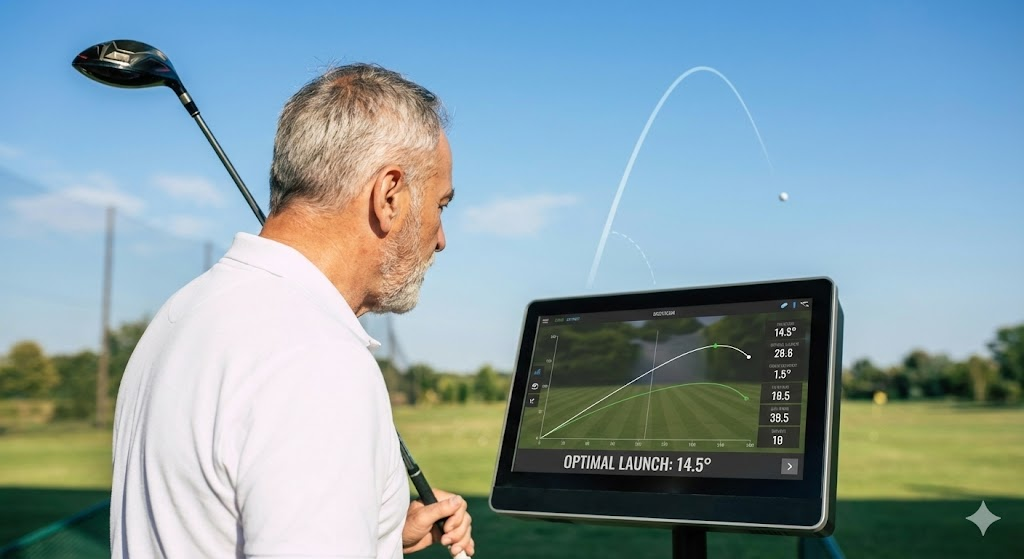
Many golfers believe distance comes from strength or speed alone. Yet distance gains remain inconsistent.
The truth is simpler.
Distance comes from efficiency. One of the most important efficiency factors is launch angle. When launch angle matches your swing and equipment, the ball flies farther with less effort.
Too low, and the ball falls out of the sky early. Too high, and spin robs carry. When launch angle sits in the right window, distance improves naturally.
This article explains how to achieve the perfect launch angle, why it matters, and how small adjustments can unlock more yardage without changing who you are as a golfer.
What Launch Angle Really Means
Launch angle describes how high the ball leaves the clubface immediately after impact. It is measured in degrees relative to the ground.
Launch angle is not the same as trajectory. Trajectory includes spin, speed, and aerodynamics. Launch angle is the starting direction.
That starting direction determines how efficiently energy transfers from club to ball.
When launch angle fits swing speed and spin rate, carry distance increases. When it does not, distance is lost quietly.
Perfect launch angle is about matching conditions, not copying numbers from professionals.
Why Launch Angle Impacts Distance So Strongly
Distance depends on how long the ball stays airborne.
Launch angle influences airtime. Too little launch reduces carry. Too much launch increases drag.
An optimal launch angle allows the ball to climb efficiently, peak properly, and descend at a playable angle.
When launch angle aligns with spin and speed, the ball flies on a strong, penetrating path.
Perfect launch angle maximizes carry without sacrificing control.
Ideal Launch Angle Ranges by Club
Perfect launch angle varies by club.
Drivers generally perform best between 12 and 16 degrees for most golfers. Faster swing speeds often use slightly lower angles. Slower speeds benefit from higher launch.
Fairway woods and hybrids usually launch between 10 and 14 degrees.
Irons launch progressively lower as loft decreases. Mid irons often fall between 16 and 20 degrees.
These ranges provide guidance, not rules. Individual swing traits matter more than charts.
Swing Speed and Perfect Launch Angle
Swing speed determines how much launch you need.
Slower swing speeds benefit from higher launch angles. The ball needs help staying airborne.
Moderate swing speeds require balanced launch. Excessive height wastes energy.
Higher swing speeds create enough ball speed to support lower launch.
Perfect launch angle always matches speed. Mismatch creates distance loss.
Angle of Attack and Launch Control
Angle of attack refers to whether the club moves up or down at impact.
With a driver, hitting slightly upward increases launch while reducing spin. This combination boosts distance.
With irons, hitting down compresses the ball properly. Launch stays controlled while spin remains useful.
Negative angle of attack with a driver lowers launch unnecessarily. Positive angle with irons causes thin shots.
Controlling angle of attack supports perfect launch angle naturally.
Ball Position and Launch Angle
Ball position strongly affects launch.
For drivers, the ball should sit inside the lead heel. For irons, position moves gradually forward as clubs get longer.
Consistent ball position stabilizes launch angle.
Small shifts often produce big distance changes.
Dynamic Loft and Its Role
Dynamic loft is the loft delivered at impact.
It differs from the club’s stated loft.
Hands ahead reduce dynamic loft. Scooping adds loft.
Too little dynamic loft lowers launch. Too much increases spin.
Perfect launch angle comes from delivering the right dynamic loft for your swing.
This balance comes from setup and sequencing rather than manipulation.
Spin Rate and Launch Angle Relationship
Launch angle and spin work together.
High launch with high spin reduces distance. Low launch with low spin drops the ball early.
Distance peaks when launch and spin complement each other.
Perfect launch angle means launch and spin are balanced, not extreme.
Reducing excess spin often improves distance more than increasing launch alone.
Equipment Influence on Launch Angle
Clubs influence launch significantly.
Driver loft affects starting angle. Shaft characteristics influence dynamic loft and spin.
Golf balls affect launch through compression and aerodynamics.
Ill-fitted equipment makes perfect launch angle difficult to achieve.
Proper fitting aligns equipment with swing tendencies.
Common Launch Angle Mistakes
Many golfers try to lift the ball.
They add loft artificially. Spin increases. Distance drops.
Others hit down excessively with drivers. Launch suffers.
Some chase tour numbers that do not fit their speed.
Understanding your own needs prevents these mistakes.
Drills to Improve Launch Angle
Simple drills create awareness.
Tee height adjustments help drivers launch properly. Higher tee encourages upward strike.
Alignment sticks help reinforce ball position.
Half swings with focus on contact improve dynamic loft control.
Drills work best when combined with feedback.
Using Feedback to Dial in Launch Angle
Feedback accelerates improvement.
Launch monitors provide precise data. Range visuals offer clues.
Ball flight tells a story. High floating shots often spin too much. Low bullets lack carry.
Learning to interpret feedback builds control.
Perfect launch angle becomes repeatable through awareness.
Course Conditions and Launch Angle
Conditions influence ideal launch.
Firm fairways reward lower launch with roll. Soft fairways favor carry.
Wind requires adjustments. Headwinds demand lower launch. Tailwinds tolerate higher launch.
Adapting launch to conditions protects distance.
Perfect launch angle remains flexible rather than fixed.
Mental Approach to Launch Optimization
Chasing launch mechanically creates tension.
Focus on setup, balance, and tempo instead.
Trust the swing. Let launch happen naturally.
Distance improves when effort decreases.
Confidence supports efficiency.
How Long It Takes to Improve Launch Angle
Improvement can happen quickly.
Small setup changes often produce immediate results.
Consistency takes practice.
Awareness accelerates learning more than repetition alone.
Patience ensures lasting gains.
Why Perfect Launch Angle Improves Scoring
More distance shortens approach shots.
Shorter approaches improve accuracy.
Confidence increases off the tee.
Perfect launch angle supports better scoring without forcing change.
Conclusion: Distance Lives in Efficiency, Not Effort
Perfect launch angle unlocks distance already present in your swing.
It does not require more strength or speed.
By optimizing ball position, angle of attack, dynamic loft, and equipment, distance improves naturally.
When launch angle fits your swing, the ball flies farther with less strain.
Efficiency beats effort every time.
FAQ
- What is the perfect launch angle for maximum distance?
It depends on swing speed, but most drivers perform best between 12 and 16 degrees. - Does higher launch always mean more distance?
No. Excessive launch often increases spin and reduces carry. - Can launch angle be improved without changing swing speed?
Yes. Setup and impact changes often improve launch immediately. - Do golf balls affect launch angle?
Yes. Compression and design influence launch and spin behavior. - Is launch angle more important than clubhead speed?
Both matter, but inefficient launch can waste speed quickly.